
 LIFESTYLE
 Introduction
A waterway barely 33 kilometres wide at its narrowest point has, once again, reminded the world how fragile global commerce can be. The Strait of Hormuz supply chain crisis has forced businesses across energy, manufacturing, retail and logistics to rethink assumptions they had treated as fixed for decades: that oil would keep flowing, that shipping lanes would stay open, and that insurance would always be available at a predictable price. None of those assumptions have held this year. With roughly a fifth of the world’s oil and gas normally passing through the strait, its disruption has rippled far beyond energy markets, touching fertiliser supplies, industrial chemicals, container shipping and inflation forecasts alike. For business leaders, this is no longer a distant geopolitical headline. It is a live operational and financial risk that demands a considered response, not a reactive one.
Key Takeaways
- The Strait of Hormuz has been effectively closed to commercial shipping since February 2026, triggering the most significant global freight disruption since the pandemic.
- War risk insurance premiums for Gulf transits have risen several-fold, and some insurers have withdrawn cover entirely.
- Rerouting via the Cape of Good Hope adds roughly 10 to 14 days to voyages and has driven freight rates sharply higher on major trade lanes.
- The crisis has compounded an already-disrupted Red Sea corridor, closing two major chokepoints simultaneously for the first time in modern shipping history.
- Diplomatic talks between Iran and Oman suggest a possible partial reopening, though terms remain unresolved and contingent on wider political conditions.
- Businesses with lean, just-in-time supply chains have been disproportionately exposed, reinforcing the case for built-in resilience over pure cost efficiency.
Why the Strait of Hormuz Matters So Much
The Strait of Hormuz sits at the mouth of the Persian Gulf, connecting oil and gas exporters including Saudi Arabia, the UAE, Qatar, Kuwait, Bahrain and Iran itself to open ocean. There is no practical alternative route for pipeline-independent volumes leaving the Gulf by sea. When the strait is disrupted, the effect is not confined to crude oil. Significant volumes of liquefied natural gas, refined fuel, ammonia and urea for fertiliser production, and industrial feedstocks such as ethylene and propylene all move through the same corridor.
This year’s disruption began in earnest in late February, when military escalation in the region led Iran’s Revolutionary Guard to declare the strait closed to shipping. Protection and indemnity war risk cover was withdrawn for Gulf transits days later, effectively making passage commercially unviable even for operators willing to accept the physical risk. More than 1,500 vessels were left stranded in and around the strait in the weeks that followed, alongside tens of thousands of crew members caught in the disruption.
The Compounding Effect: Two Chokepoints at Once
What has made this disruption unusually severe is timing. The Red Sea corridor, long affected by Houthi attacks on commercial vessels, had shown tentative signs of recovery in late 2025. That recovery reversed sharply once the Hormuz crisis began, as attacks on Red Sea shipping resumed. For the first time in modern maritime history, two of the world’s most critical shipping chokepoints have been effectively closed simultaneously, leaving carriers with limited practical alternatives.
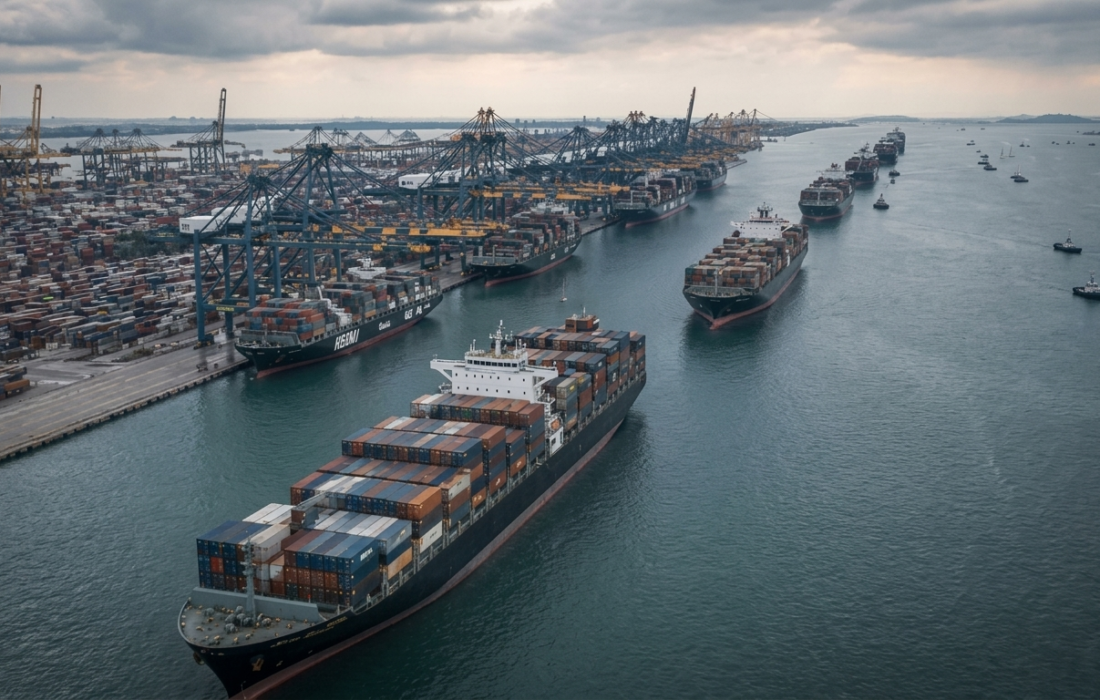
Most major shipping lines have rerouted vessels around the Cape of Good Hope, adding an estimated 3,500 to 4,000 nautical miles and 10 to 14 days to typical Asia-to-Europe and Asia-to-Middle East voyages. That extra distance does not simply mean later deliveries. It effectively removes shipping capacity from the global fleet, since vessels spend longer at sea completing each round trip, tightening available capacity even where nominal fleet size has not changed.
The Financial Toll on Business
The cost impact has landed across several categories at once rather than in a single, easily modelled line item. War risk insurance premiums for vessels attempting Gulf transits have risen sharply, with some underwriters withdrawing capacity for the region entirely regardless of price. Emergency conflict surcharges have been applied by major carriers on cargo to and from Gulf ports, layered on top of already elevated base freight rates. Transpacific and Asia-to-Europe container rates have both risen substantially compared with pre-crisis baselines, driven by the combination of surcharges, rerouting costs and tightened capacity.
Analysts at reinsurance intelligence firm Howden Re have described the episode as one of the most significant multi-line insurance events in decades, testing marine, energy, aviation and political risk coverage simultaneously across the global reinsurance market. For businesses reliant on Gulf-linked trade lanes, that has translated into materially higher landed costs, extended lead times, and, in some cases, a genuine scramble for alternative sourcing.
A Practical Example
Consider a UK-based manufacturer of industrial plastics that sources ethylene feedstock from Gulf producers and exports finished components to customers across Europe and Asia. Before the crisis, the business operated a lean, just-in-time inventory model built around predictable four-week transit times. When the strait closed, its usual supply route became commercially unavailable overnight, forcing the company to source feedstock from more distant, costlier suppliers while absorbing a two-week extension on outbound shipments rerouted via the Cape of Good Hope. The business survived the disruption, but only by drawing on cash reserves it had not expected to need and by renegotiating customer delivery terms it had previously treated as fixed. Companies that had already diversified suppliers and built modest inventory buffers before the crisis weathered it considerably more comfortably.
Comparison Table
| Factor | Pre-Crisis Baseline | During Hormuz/Red Sea Disruption |
|---|---|---|
| Typical Asia–Europe transit time | Approx. 30–35 days via Suez | 40–49 days via Cape of Good Hope |
| War risk insurance (Gulf transit) | Low, stable premiums | Several-fold increase; some cover withdrawn |
| Container freight rates | Stable, seasonally variable | Sharply elevated with emergency surcharges |
| Available effective fleet capacity | Full nominal capacity | Materially reduced due to longer voyages |
| Sourcing flexibility required | Standard supplier relationships | Active diversification and buffer stock |
Common Mistakes Businesses Make
Many companies treat a chokepoint disruption as a temporary anomaly rather than a structural risk worth planning around, even though the pattern of major maritime disruptions — the Suez blockage in 2021, Panama Canal drought restrictions in 2023, the Red Sea crisis from late 2023 onward, and now Hormuz — has become increasingly frequent. Assuming “this will pass quickly” without contingency planning leaves businesses repeatedly exposed to the same category of shock.
A second common mistake is focusing purely on headline freight rates while overlooking the full cost stack. War risk surcharges, emergency congestion fees and insurance repricing can widen the gap between quoted base rates and actual invoiced costs considerably, and businesses that fail to audit all-in costs are often caught off guard by margin erosion they did not see coming.
A third mistake is under-investing in supply chain visibility technology. Research cited by supply chain analysts, including a McKinsey survey from December 2025, found that the proportion of companies planning major digital supply chain investment had actually fallen year-on-year, even as disruption frequency increased. Separately, Gartner research has highlighted that only a small minority of supply chains are currently capable of real-time decision-making. That gap between rising risk and static investment leaves many organisations structurally unprepared for the next disruption, whatever form it takes.
Future Trends: Where This Risk Goes Next
Diplomatic talks between Iran and Oman have progressed towards a possible partial reopening of the strait, with a proposed arrangement involving separate inbound and outbound shipping routes. Any resolution, however, appears contingent on wider political conditions, including the status of a US blockade on Iranian ports, and analysts remain divided on how durable any near-term agreement would prove.
Looking further ahead, three trends seem likely to persist regardless of how this specific crisis resolves. First, marine war risk insurance appears to be undergoing a structural repricing rather than a temporary spike, with underwriters treating chokepoint risk as a recurring feature of the operating environment rather than a one-off event. Second, businesses with meaningful exposure to Gulf-linked trade are likely to accelerate supplier diversification and nearshoring conversations that had previously been discussed but deprioritised on cost grounds. Third, expect growing corporate investment in real-time supply chain visibility tools, driven less by efficiency ambitions and more by the basic need to react faster than competitors when the next chokepoint disruption arrives — because, on recent evidence, another one likely will.
Frequently Asked Questions
What caused the Strait of Hormuz supply chain crisis? Military escalation in the region in early 2026 led Iran’s Revolutionary Guard to declare the strait closed to commercial shipping. War risk insurance cover was subsequently withdrawn for Gulf transits, making passage commercially unviable for most carriers even where physical transit remained technically possible.
How much of global oil trade passes through the Strait of Hormuz? Roughly a fifth of the world’s oil and gas has typically moved through the strait in recent years, making it one of the most strategically important maritime chokepoints for global energy supply.
How are businesses rerouting shipments during the crisis? Most major carriers have shifted to the Cape of Good Hope route around southern Africa, which adds approximately 10 to 14 days and thousands of additional nautical miles to typical Asia–Europe and Asia–Middle East voyages.
Why have freight rates risen so sharply? Rates have risen due to a combination of emergency war risk surcharges, longer voyage distances reducing effective fleet capacity, and tightened insurance availability, all compounding simultaneously rather than in isolation.
Is the Red Sea route also affected? Yes. Renewed attacks on Red Sea shipping have coincided with the Hormuz disruption, meaning two major global shipping chokepoints have been effectively closed at the same time — an unprecedented situation in modern shipping history.
What can businesses do to protect themselves from chokepoint disruptions? Practical steps include diversifying suppliers across multiple regions, maintaining modest inventory buffers rather than pure just-in-time models, auditing full landed costs rather than headline freight rates, and investing in supply chain visibility tools that support faster decision-making.
Will the Strait of Hormuz reopen soon? Diplomatic talks between Iran and Oman have progressed towards a proposed partial reopening, though any resolution appears contingent on broader political conditions and its durability remains uncertain.
Final Thoughts
The Strait of Hormuz supply chain crisis is, in one sense, a story about a single waterway. In a more important sense, it is a story about how thin the margin for error has become in global trade. Businesses spent years optimising supply chains for cost and speed, often at the expense of redundancy. This year’s disruption has been a sharp reminder that redundancy is not waste; it is insurance against exactly this kind of event. Whatever the outcome of current negotiations, the underlying pattern of increasingly frequent chokepoint disruptions is unlikely to reverse. The organisations that treat resilience as a permanent operating discipline, rather than a temporary crisis response, will be the ones best placed to withstand whichever chokepoint disrupts global trade next.