 AI
AI The artificial intelligence race has entered a new phase.
For much of the generative AI boom, the industry’s most valuable commodity appeared to be the graphics processing unit. Nvidia’s chips became symbols of an extraordinary scramble for computing power, as technology companies competed to train increasingly capable models.
But beneath that semiconductor race, a much larger infrastructure contest is emerging.
AI needs chips. Chips need data centres. And data centres need electricity — enormous quantities of it.
From gigawatt-scale campuses in the United States to new AI infrastructure corridors across Europe, Asia and the Middle East, access to reliable power is becoming a strategic asset in the artificial-intelligence economy.
The question facing technology companies may therefore be shifting from “How many GPUs can we buy?” to “Where can we power them?”
The IEA’s figures make that argument highly defensible: global data-centre electricity consumption is projected to approach 945 TWh by 2030 — roughly double the 415 TWh consumed in 2024 — while electricity consumed by AI-focused “accelerated servers” is rising by about 30% a year, more than three times the 9% growth rate of conventional servers. Overall data-centre demand is growing around 15% annually through the decade, more than four times faster than electricity demand from every other sector combined.
And there is a 2026 number that makes the scale viscerally clear: capital expenditure by five major technology companies exceeded $400 billion in 2025, and the IEA expects it to rise a further 75% in 2026.
That gives us our opening.
1. How did AI turn into an infrastructure race?
The first AI race was simple to describe: models → GPUs → compute. Whoever trained the best model, on the most chips, won the news cycle.
The race emerging now looks nothing like that. It looks more like this:
Land → electricity → grid connection → data centre → cooling → fibre → GPUs → AI.
That distinction matters more than it first appears to. A company can, in principle, buy GPUs — write the check, wait for the shipment. It cannot necessarily obtain a gigawatt of electricity at the location it wants within two years, no matter how large the check is.
The IEA makes this mismatch explicit: a data centre can potentially be operational within two to three years, while the electricity generation, transmission, and grid infrastructure it depends on frequently require much longer planning and construction cycles — often five to ten years for new generation or transmission capacity.
That is the fundamental economic tension behind this entire story. The industry has gotten very good at building data centres quickly. It has not solved the much slower, much more regulated problem of building the power to run them.
2. From megawatts to gigawatts
For most of the data centre industry’s history, projects were discussed in megawatts — a few tens, occasionally a couple hundred. Today, the unit of account is shifting to gigawatts, and the pace of that shift is startling.
Hut 8 illustrates it well. This month, the company fully commercialised its Beacon Point AI campus in Texas: a second 352 MW, 15-year lease to the same undisclosed high-investment-grade tenant, doubling that customer’s contracted capacity at the site to 704 MW within a roughly 1 GW campus. Combined, the two leases bring Beacon Point’s base-term contract value to $19.6 billion — a figure that could rise to $50.2 billion if the tenant exercises its renewal options.
Then there is a proposal reported this week that goes further still. Nvidia is reportedly in discussions to financially back OpenAI’s lease of a planned 10 GW data centre campus in Pike County, Ohio, on the site of the former Portsmouth Gaseous Diffusion Plant — a Cold War-era uranium enrichment facility now being eyed for the opposite kind of energy-intensive future. Reuters, citing the Wall Street Journal and The Information, reports the project could cost more than $500 billion, with Nvidia potentially guaranteeing as much as $250 billion of the financing, and developer SB Energy (backed by SoftBank) targeting a first 800 MW phase online around 2028. The arrangement is a 20-year lease and remains under discussion — nothing here is signed, and the full 10 GW, if it happens at all, is years away.
Ten gigawatts is no longer simply a technology project. For comparison, that is in the range of a mid-sized country’s entire generating capacity. It is approaching the scale of a major national infrastructure programme — negotiated, for now, between a chipmaker, an AI lab, and a power developer, rather than a government.
3. The real AI bottleneck: the grid
The reader’s instinct is to assume the scarce resource is still the chip. It isn’t — or rather, it no longer is on its own. AI infrastructure now runs into several interconnected scarcity problems simultaneously:
Power availability. Can the local grid actually supply hundreds of megawatts continuously, not just at peak?
Grid connection. Even where generation exists, transmission and interconnection queues can take years to clear — in parts of the US, interconnection queue waits now regularly exceed the construction time of the data centre itself.
Transformers and substations. A hyperscale campus needs enormous surrounding electrical infrastructure, and large power transformers are themselves on multi-year backorder globally.
Cooling. High-density GPU racks generate extraordinary heat loads that air cooling increasingly cannot handle, pushing the industry toward liquid cooling at scale.
Land. Power-rich land with fibre connectivity and the right permitting status is becoming a distinct and increasingly valuable asset class in its own right — which is why operators are chasing sites in Texas, Louisiana, and Ohio rather than simply expanding existing hubs.
Water. Some cooling architectures introduce a second resource constraint on top of electricity, one that is already a flashpoint in drought-prone build sites.
China offers the most literal illustration yet of how far operators will go to escape these constraints simultaneously. Shanghai Hailanyun Technology (HiCloud) switched on what it calls the world’s first wind-powered underwater data centre in May 2026, submerged roughly ten metres off the coast of Shanghai’s Lin-gang area, powered by an adjacent offshore wind farm and cooled passively by the surrounding seawater. At 24 MW and roughly $228 million, it’s small by hyperscale standards — but it is a direct, engineered answer to three of the six constraints above at once: it uses no land, needs no active cooling water draw, and its power source sits next to it rather than competing for grid capacity. HiCloud built an earlier module off Hainan in 2023 and reports 40-60% better power efficiency than a comparable land-based facility, though marine biologists have raised questions about localised thermal discharge into the surrounding water. Whether this scales beyond a few thousand servers is unproven, but it’s a genuine data point in section 7’s argument: operators are already treating the standard data-centre model — land, grid, active cooling — as something to engineer around rather than a fixed cost of doing business.
Framed this way, “AI uses a lot of energy” becomes a much sharper and more useful argument: AI infrastructure is now gated by the slowest-moving link in a chain of six scarce inputs, not the fastest-moving one.
4. Where will the AI capitals of the future actually be?
Ranking countries by number of AI startups is a familiar exercise and not a very useful one. Ranking them by the underlying factors that determine where gigawatt-scale infrastructure can actually get built is more interesting — and gives this piece a genuinely global business perspective instead of another US-centric AI story.
| Factor | Why it matters |
|---|---|
| Available power | Determines achievable AI capacity |
| Cost of electricity | Directly affects operating economics |
| Grid interconnection | Determines deployment speed |
| Land | Large campuses need enormous sites |
| Fibre connectivity | Compute still needs high-speed networks |
| Water/cooling | Increasing constraint with dense GPU clusters |
| Regulation | Permitting can accelerate or kill projects |
| Capital | Projects increasingly cost billions |
| Renewable/nuclear availability | Important for long-term supply |
| Political stability | Infrastructure is built for decades |
United States — still the centre of gravity, but increasingly decentralised: Texas (grid + gas + land), Ohio (grid + a very unusual federal land parcel), Louisiana (Meta’s 5 GW Hyperion ambition, on the back of new gas generation), Virginia (the legacy hub, now power-constrained), and a widening set of inland sites — Indiana, Wisconsin, Mississippi — chosen specifically because they aren’t Virginia.
United Kingdom — real investment momentum (Microsoft, Google, and Nscale have all committed billions), channelled through government-designated “AI Growth Zones,” but genuinely constrained by power availability around London, pushing projects toward the North East and Essex instead.
Nordics — Finland, Sweden and Norway offer a rare combination: cold climates that cut cooling costs and abundant, often hydro-based electricity. Stargate Norway (OpenAI, Nscale and Aker) is a live test of whether that combination scales.
Middle East — cheap capital, cheap energy, and explicit state ambition. Abu Dhabi’s Stargate UAE and Saudi Arabia’s Humain programme (targeting 6.6 GW by 2034, backed by the PIF) show sovereign wealth being deployed directly into physical AI infrastructure, not just funds that invest in it.
India — enormous digital demand meets a much harder physical equation: grid reliability, transmission quality, and cooling economics are not yet where hyperscale AI campuses need them to be, even as Reliance and Adani commit tens of billions toward closing that gap.
Singapore — best-in-class connectivity and regulatory environment, undercut by the most basic constraints of all: it is a small, land-scarce country with limited domestic power generation, which is precisely why so much Southeast Asian capacity is now landing in Malaysia instead.
China — arguably the most important omission in most Western coverage of this story, and a market operating on entirely different rules. Beijing is reportedly weighing roughly $295 billion in state-backed data centre spending over five years, to be built largely by China Mobile and China Telecom on Huawei-supplied chips rather than Nvidia’s — a deliberate bet that domestic energy abundance and state-directed capital can substitute for restricted access to the best foreign silicon. The state-run “East Data West Computing” programme is already routing compute-hungry eastern demand toward cheap power and land in China’s west, with eight national computing hubs now accounting for roughly 70% of national computing capacity and national data centre capacity targeted to roughly double to 60 GW by 2030. Layered on top, Alibaba and ByteDance are each running independent, multi-billion-dollar domestic buildouts (roughly 2 GW and 1.5 GW of 2026 demand, respectively). It’s a structurally different model from the West’s hyperscaler-and-sovereign-fund approach — state-directed, chip-restricted, and power-abundant — and it may end up being the strongest test yet of whether cheap, plentiful electricity can substitute for cutting-edge compute.
5. Follow the money: who actually gets rich from the AI infrastructure boom?
Most coverage stops at Nvidia, Microsoft, Amazon, Google and OpenAI. The more interesting business question sits one layer underneath.
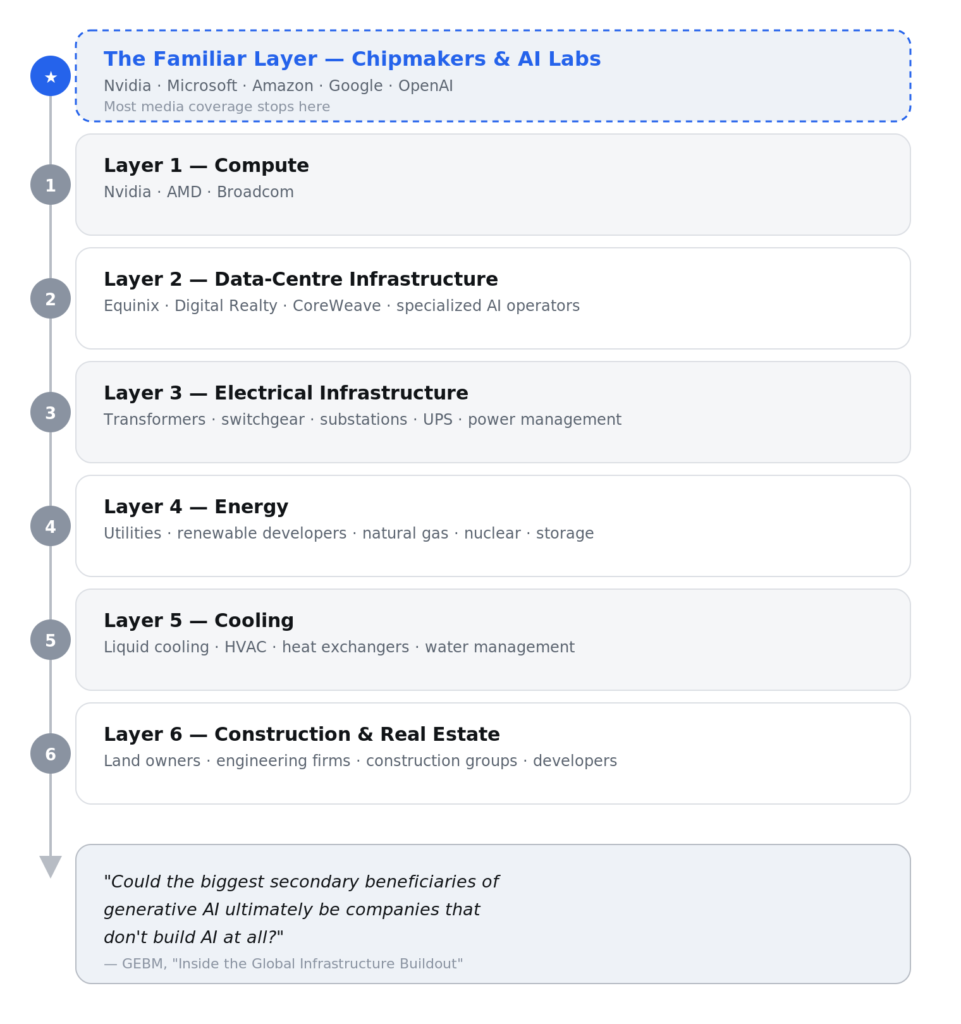
That produces a sharper question than the usual “who wins AI”: could the biggest secondary beneficiaries of generative AI ultimately be companies that don’t build AI at all — the gas turbine makers, the transformer manufacturers, the land owners in Abilene and Richland Parish? For an investment or business readership, that is a far more interesting argument than another Nvidia valuation debate.
6. The twist: what happens if we build too much?
None of the above should read as an uncomplicated hype piece. Hundreds of billions of dollars are being committed on a single assumption: that AI compute demand keeps rising at close to its current, extraordinary rate, indefinitely.
That assumption could break in several ways. Model efficiency keeps improving. Inference keeps getting cheaper per query. Smaller, specialised models replace giant general-purpose ones for many tasks. GPU utilisation improves. New chip and data-centre architectures do more with less electricity. Or, simplest of all, AI revenues fail to grow into the infrastructure built to serve them.
If any combination of those materialises faster than the industry expects, today’s power shortage could become tomorrow’s compute overcapacity — gigawatt campuses built for a demand curve that bent before they finished construction. It’s the same tension the Bank for International Settlements flagged in its June 2026 Annual Report, when it named an AI capex bust — alongside opaque “circular financing” arrangements and record sovereign debt — as one of the fault lines most likely to crack the broader financial system. That tension is what makes this argument credible rather than promotional: the industry itself is building as if the answer is already known, when it isn’t.
7. The emerging solution: data centres that talk back to the grid
The most interesting research emerging in 2025–2026 doesn’t ask “how do we build enough electricity for AI?” It asks a different question: can AI data centres change when they consume electricity?
A 2025 real-world trial on a 256-GPU cluster showed that software orchestration could cut that cluster’s electricity consumption by 25% for three-hour windows during periods of grid stress, without breaching service requirements. More recent 2026 research is going further, examining gigawatt-scale facilities that dynamically coordinate compute workloads, on-site batteries, and available grid capacity in real time.
That points to a genuinely different endpoint than the one implied by sections 1 through 6: AI data centres as flexible participants in the electricity grid — able to throttle non-urgent workloads during demand spikes and absorb surplus power when it’s cheap — rather than simply enormous, static consumers that grids are forced to build around. It’s forward-looking without drifting into speculation, and it’s the natural place to end a piece that otherwise reads as one long list of constraints.
The GEBM AI Infrastructure Tracker — 2026
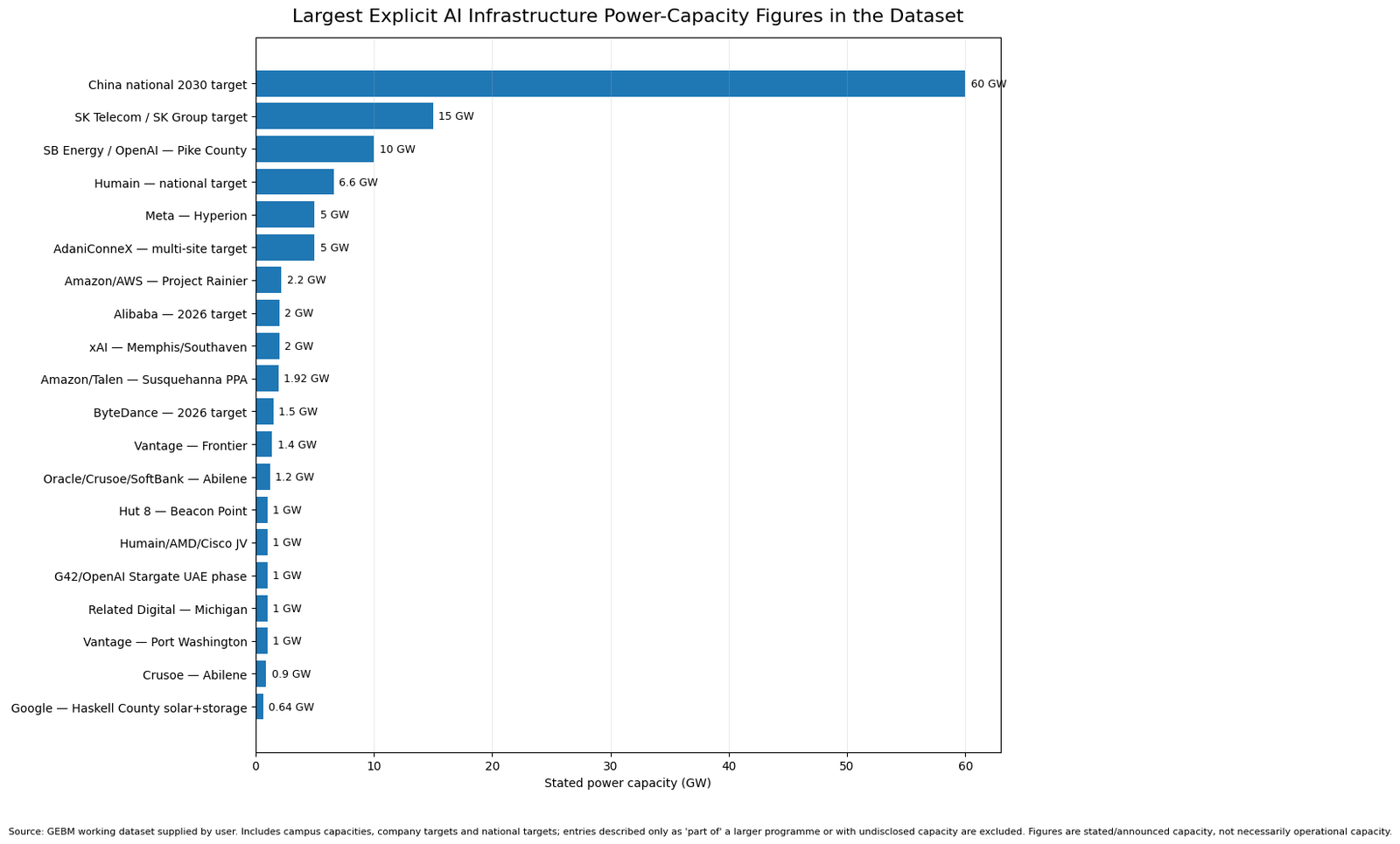
To move beyond citing others’ research, GEBM compiled its own dataset: 55 major AI power-infrastructure announcements from January 2025 through July 2026, spanning the US, UK, Nordics, Middle East, India, China, East Asia, Southeast Asia, Australia and Brazil. Each entry is flagged Confirmed (company/SEC-sourced) or Reported (media-sourced, unconfirmed by the parties involved) — a distinction the underlying reporting frequently blurs but that matters enormously for a serious business readership.
Note on the table: figures mix hard, currently-contracted capacity with multi-year aspirational targets (e.g., “6.6 GW by 2034”). Several entries show capacity as “undisclosed” because operators folded per-site numbers into an aggregate program total (OpenAI’s ~7 GW/$400bn “five new Stargate sites,” for instance) rather than disclosing them individually — meaning the true global total is almost certainly higher than the sum of disclosed figures below. Left border colour indicates confidence: blue = Confirmed, orange = Reported.
GEBM analysis of the tracker
Across these 55 tracked deals, disclosed capacity totals roughly 95-105 GW once China’s national target is included, split unevenly between figures the companies and states themselves have confirmed (~78-85 GW, including Meta’s Hyperion, Amazon’s Indiana campuses, xAI’s Colossus, Vantage’s Frontier, Humain’s and Adani’s multi-gigawatt targets, and China’s own stated 60 GW-by-2030 national target) and figures that remain media-reported and unconfirmed by the parties involved (~25-26 GW) — a gap still dominated by the single largest unconfirmed number in the dataset, the proposed 10 GW OpenAI/Nvidia/SB Energy Ohio campus, alongside China’s reported (not yet finalised) $295B state spending plan.
Disclosed investment tells a similar story: roughly $600 billion in confirmed capital commitments across named Western/Middle East/Indian projects, against a further $500 billion-plus in reported-but-unconfirmed Ohio spending and a potential further $295 billion in reported (not yet finalised) Chinese state spending. China’s own confirmed corporate capex — Alibaba’s $53B three-year commitment and ByteDance’s $23B for 2026 alone — adds roughly $75 billion more in figures companies have already disclosed themselves, on top of the state plan.
Once China is included, the “who’s building the most” picture changes meaningfully: it is no longer simply a US-versus-everyone-else story. China’s stated national ambition — 60 GW of data centre capacity by 2030 — is in the same order of magnitude as confirmed US capacity, even though it’s being pursued through a structurally different model: state-directed capital, domestic Huawei silicon rather than Nvidia chips (due to export restrictions), and power sourced from a coal/hydro/nuclear mix skewed toward China’s cheaper, less power-constrained west. GEBM’s analysis found that a small handful of markets — the US, China, the Middle East and India — now account for the overwhelming majority of both disclosed capacity and disclosed capital.
Three patterns stand out. First, gas — not renewables, and not nuclear — is the fastest-deploying power source in the current wave of US megaprojects (Ohio, Louisiana, Texas, El Paso), because it can be sited and built faster than new transmission or renewable generation, even as companies simultaneously sign long-dated nuclear and SMR deals for the 2030s. Second, roughly a third of the tracked projects disclose no per-site capacity figure at all, because operators are folding individual sites into aggregate program totals (OpenAI’s “~7 GW/$400bn” five-site Stargate announcement, for instance) — a reporting pattern that itself says something about how these companies want the scale of the buildout perceived. Third, China is the one major market treating physical constraints as an engineering problem to route around rather than a siting problem to negotiate — its underwater, wind-powered data centre off Shanghai answers the land, water and grid-connection constraints simultaneously, at a scale (24 MW) too small to matter yet, but conceptually ahead of anything announced elsewhere in this tracker.
Methodology note: this is a representative sample of major, well-documented announcements rather than an exhaustive census, and treats disclosed figures at face value — company-stated capacity targets years out (e.g., Humain’s 6.6 GW “by 2034”) are not the same as capacity under contract today. Given the pace of new announcements — several per week as of mid-2026 — this table is a snapshot as of late July 2026 and would need to be refreshed for any future citation.
The AI industry spent two years arguing about who had the best model. It may spend the next several arguing about who has the cheapest, fastest, most reliable megawatt — and the answer to that question may end up mattering more.