
UK Visa Routes in 2026: A Guide to Work, Talent, Study, Family and Settlement
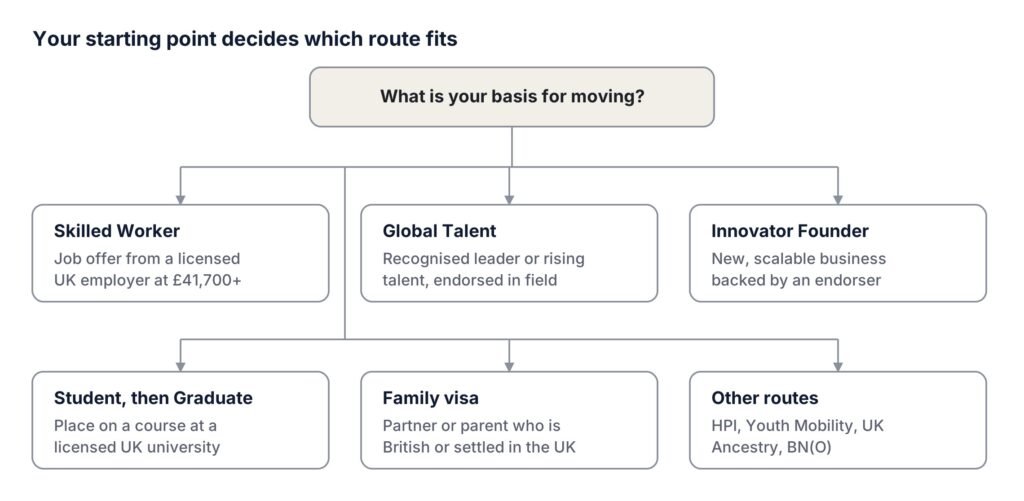
UK visa routes fall into five doors, and most people move here through one of them: a sponsored job, a talent or founder endorsement, study, family, or a youth or heritage scheme. Each has its own costs, freedoms and path to permanent residence. The rules have tightened since 2025: the Skilled Worker salary floor is now £41,700, the Graduate visa drops to 18 months from 1 January 2027, and the government has announced an “earned settlement” model that could double the standard wait for permanent residence from 5 to 10 years. As of the Statement of Changes laid on 3 September 2026 (HC 584), that settlement overhaul is not yet law, so the current 5-year rules still apply.
This guide sets out all the main UK visa routes in plain terms so you can see which ones fit your situation before speaking to an adviser.
At a glance
Among UK visa routes, those that lead to settlement fastest are Global Talent (3 years as a leader) and Innovator Founder (3 years); the most common is Skilled Worker (5 years). Fees below are the main applicant fee from outside the UK; most routes also charge the Immigration Health Surcharge of £1,035 per person per year.
| Route | Who it suits | Sponsor or endorsement | Initial length | Leads to settlement | Application fee |
|---|---|---|---|---|---|
| Skilled Worker | Professionals with a UK job offer | Licensed employer | Up to 5 years | Yes, after 5 years | £819 (up to 3 yrs), £1,618 (over 3 yrs) |
| Global Talent | Leaders and emerging leaders in tech, research, arts | Endorsing body (e.g. Tech Nation) | Up to 5 years | Yes, after 3 or 5 years | £766 (in two parts) |
| Innovator Founder | Founders with a new, scalable business | Approved endorsing body | 3 years | Yes, after 3 years | £1,357 + £1,000 endorsement |
| High Potential Individual | Recent graduates of top global universities | None | 2 years (3 for PhD) | No | See GOV.UK |
| Student then Graduate | Students at UK universities | University (Student only) | Course length, then 18 months to 2 years | No (switch needed) | Graduate: £937 |
| Family (partner) | Partners of British citizens or settled people | UK partner | 2 years 9 months | Yes, after 5 years | See GOV.UK |
| UK Ancestry | Commonwealth citizens with a UK-born grandparent | None | 5 years | Yes, after 5 years | £726 |
| Youth Mobility Scheme | 18 to 30 (or 35) year olds from participating countries | None | 2 years (some up to 3) | No | £340 |
Sponsored work routes
Sponsored UK visa routes tie you to a licensed UK employer: you need a job offer and a certificate of sponsorship before you apply, and you must update your visa if you change jobs.
Skilled Worker. The main route for professionals. Your job must be on the eligible occupations list and pay at least £41,700 a year or the going rate for the role, whichever is higher. Some applicants (for example new entrants or PhD holders) can qualify on £33,400. You must prove your English and usually show £1,270 in savings held for 28 days.
- Fees: £819 (up to 3 years) or £1,618 (over 3 years) from outside the UK; £943 or £1,865 from inside. Lower fees apply for jobs on the immigration salary list.
- Length: up to 5 years, renewable. Settlement is currently possible after 5 years.
- Family: partner and children can join as dependants.
Health and Care Worker. For qualified doctors, nurses, health professionals and adult social care professionals working for the NHS, an NHS supplier or in adult social care. It is cheaper than Skilled Worker, and you and your dependants do not pay the Immigration Health Surcharge. Decisions usually take 3 weeks.
Global Business Mobility. A family of temporary routes for staff that an overseas employer is sending to the UK, such as senior or specialist workers on intra-company transfers. These routes do not lead to settlement on their own.
Scale-up. For people with a job offer from a fast-growing UK business approved as a scale-up sponsor. After the first 6 months you can change employer without a new sponsor.
Talent and innovation routes
These UK visa routes need no job offer, which gives far more freedom to change roles, freelance or start a business.
Global Talent. For leaders (Exceptional Talent) and potential leaders (Exceptional Promise) in digital technology, academia and research, or arts and culture. Most applicants first need an endorsement from a field body; for digital technology this is Tech Nation, with decisions usually in 5 to 8 weeks. Winners of an eligible prize can skip endorsement.
- Fee: £766 in total, paid as £561 for endorsement and £205 for the visa.
- Freedoms: be employed, self-employed or a company director, and change jobs without telling the Home Office. No salary or English requirement.
- Settlement: after 3 years as a leader or 5 years as a potential leader.
High Potential Individual. For graduates of top-ranked universities outside the UK, awarded their degree in the last 5 years. It gives 2 years (3 for a PhD) to work or look for work, with no sponsor. There is a yearly cap, it cannot be extended, and time on it does not count towards settlement, so most holders later switch to Skilled Worker or Global Talent.
Innovator Founder. For founders setting up a new, innovative, viable and scalable business, endorsed by an approved body.
- Fees: £1,357 from outside the UK, plus £1,000 to the endorsing body and £500 for each progress check (at least two).
- Length: 3 years, renewable. Settlement possible after 3 years.
- You can also take outside work in roles needing at least a level 3 qualification.
Study routes
Study-based UK visa routes are a common first step, but neither leads to settlement by itself; graduates usually switch to a work or talent visa.
Student. For people 16 or over with a place on a course at a licensed sponsor. The fee is £558, plus the healthcare surcharge. Degree-level students can usually stay up to 5 years. Work is limited during term time, and self-employment is not allowed.
Graduate. Lets you stay and work in almost any job after a UK degree, with no sponsor. It lasts 2 years if you apply on or before 31 December 2026, and 18 months from 1 January 2027 (3 years for a PhD). The fee is £937. It cannot be extended, so plan the switch to Skilled Worker or Global Talent early.
Family routes
Family UK visa routes depend on your relationship to someone who is British, Irish or already settled in the UK.
Partner or spouse. For married partners, civil partners, fiancé(e)s, or couples together for at least 2 years. You usually need a combined income of at least £29,000 a year (savings can sometimes count instead) and a good knowledge of English.
- Length: 2 years 9 months at first, then extensions of 2 years 6 months.
- Settlement: after 5 continuous years as a partner. Those who cannot meet the financial requirement face a 10-year route.
- Decisions: usually 12 weeks from outside the UK.
Parent, child and adult dependent relative. Separate routes exist for parents of children in the UK, children joining parents, and adults who need long-term care from a relative here. The adult dependent relative route is notably hard to qualify for.
UK Ancestry. For Commonwealth citizens (and some British nationals) with a grandparent born in the UK, the Channel Islands or the Isle of Man. It costs £726, lasts 5 years, allows any kind of work, and can lead to settlement after 5 years.
Other routes
Youth Mobility Scheme. Lets 18 to 30 year olds (18 to 35 for some countries) from participating countries live and work in the UK for up to 2 years. It costs £340 plus a reduced healthcare surcharge of £776 a year, and you need £2,530 in savings. Citizens of Australia, Canada and New Zealand can extend by a year. It does not lead to settlement.
British National (Overseas). For BN(O)s from Hong Kong, their adult children born on or after 1 July 1979, and family members. You choose 2 years 6 months or 5 years, can work and study freely, and can apply to settle after 5 years.
Visitors and the ETA. Visitors cannot live or work in the UK. Nationals who do not need a visa for short trips now usually need an Electronic Travel Authorisation before travelling.
Settlement and citizenship
Settlement, or indefinite leave to remain (ILR), removes all time limits on your stay. Under the rules in force today it usually comes after 5 years on the main work and family routes, or 3 years on Global Talent (as a leader) and Innovator Founder. You must also pass the Life in the UK test and meet the English requirement.
What is changing. In November 2025 the government published its earned settlement proposals, which would make 10 years the default qualifying period, shortened or lengthened by contribution:
- Taxable income of £125,140 for 3 years before applying would cut the wait to 3 years; £50,270 would cut it to 5 years.
- Time claiming public funds would add 5 or 10 years.
- The standalone 10-year long residence route would be abolished.
The Home Secretary has said the changes will arrive in autumn 2026 and apply to people already in the UK. However, the Statement of Changes laid on 3 September 2026 (HC 584) did not include them, so the current rules still apply until a further statement is laid. Separately, a higher B2 English requirement for several settlement routes takes effect on 26 March 2027. Anyone close to qualifying under the current rules should consider applying as soon as they are eligible.
Citizenship. Most settled people can apply to become a British citizen 12 months after getting ILR, or straight away if married to a British citizen, subject to residence, English and good character requirements.
Choosing between UK visa routes
Start from what you already have: a job offer, a track record, a university place, a family tie, or a qualifying nationality or heritage.