
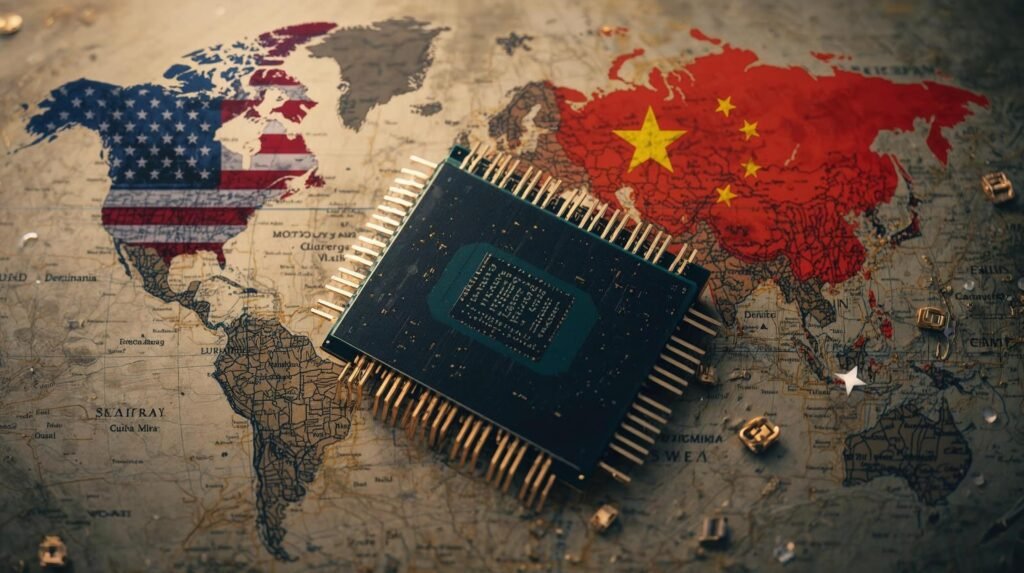
Semiconductors have become a strategic asset in the global contest for technological and economic power.
Semiconductors were once an obscure component buried deep inside electronic devices, noticed only by engineers and supply managers. Today, they sit at the centre of global power politics. From artificial intelligence and defence systems to cars and consumer electronics, advanced chips have become the backbone of modern economies — and a key instrument of geopolitical leverage.
The escalating rivalry between the United States and China has transformed semiconductors into a strategic asset on par with energy, finance and defence. Control over chip design, manufacturing and supply chains is no longer just about economic competitiveness; it is increasingly framed as a matter of national security.
Why Chips Matter More Than Ever
At the heart of today’s technological revolution are advanced processors that power data centres, AI models, military systems and next-generation communications. High-performance chips, particularly graphics processing units (GPUs), are essential for training artificial intelligence and running complex simulations.
Unlike many raw materials, semiconductors are extraordinarily difficult to produce. Manufacturing requires specialised equipment, rare materials and years of expertise. Only a handful of countries and companies control the most advanced stages of chip production, making supply chains fragile and politically sensitive.
The US-China Tech Rivalry
Tensions between Washington and Beijing have brought this vulnerability into sharp focus. The United States has sought to restrict China’s access to advanced chips and chipmaking tools, arguing that cutting-edge semiconductors could enhance military capabilities and undermine global security.
China, meanwhile, has accelerated efforts to build domestic alternatives, pouring state support into chipmakers and research programmes. The result is a technological decoupling that is reshaping global supply chains, forcing companies and governments to choose sides or redesign operations to reduce exposure.
The CHIPS Act and the Push for Resilience
In response to supply disruptions and strategic risks, the United States has launched large-scale initiatives to rebuild semiconductor manufacturing capacity at home. Policies such as the CHIPS Act are designed to reduce dependence on overseas production and ensure access to critical technologies.
This approach reflects a broader shift in thinking. Efficiency and low-cost globalisation are no longer the sole priorities. Governments are now willing to pay a premium for resilience, security and strategic autonomy — even if it means duplicating supply chains or intervening heavily in markets.
Supply Chains as Strategic Weapons
Semiconductors illustrate how supply chains themselves have become tools of influence. Export controls, licensing requirements and investment restrictions are now routinely used to shape technological outcomes. For countries that rely heavily on imported chips, access can no longer be taken for granted.
This has significant implications for industries ranging from automotive manufacturing to cloud computing. Shortages or restrictions can ripple across economies, slowing growth and exposing vulnerabilities that were previously overlooked.
A Global Race With No Easy Winners
While much attention focuses on the US and China, other regions are also caught in the middle. Countries in Europe and Asia are investing heavily to secure their place in the semiconductor ecosystem, balancing alliances with economic interests.
For businesses, the challenge is navigating a world where technology decisions are inseparable from geopolitics. For governments, the stakes are even higher. Control over semiconductors increasingly means influence over the pace of innovation, economic strength and strategic power.
The New Front Line of Global Power
The chip wars are not about one product or one country. They represent a deeper struggle over who sets the rules of the digital age. As artificial intelligence, automation and advanced computing reshape societies, semiconductors will remain the foundation on which future power is built.
In this new era, mastery of chips is no longer a technical advantage — it is a geopolitical one.
Source
- Editorial analysis informed by public reporting from international business and policy coverage on semiconductor supply chains, the US-China tech rivalry, and global chip security discussions.