
A Nation Repositioning Itself
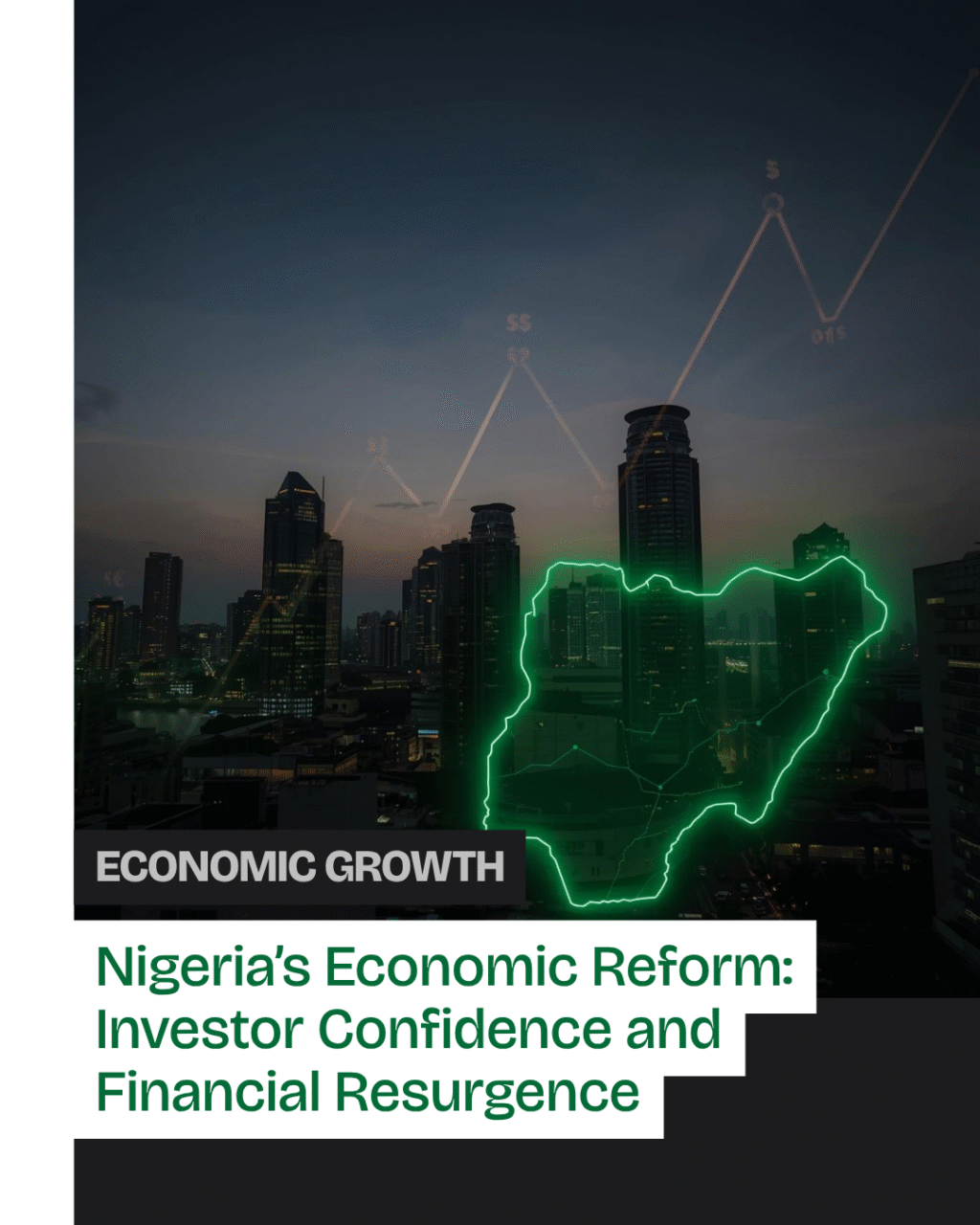
For decades, Nigeria has been viewed as Africa’s sleeping giant — rich in potential but restrained by policy instability, corruption, and over-reliance on oil. But in 2025, the country appears to be writing a different story. A bold wave of economic reforms under President Bola Ahmed Tinubu’s administration is slowly restoring global investor confidence, positioning Nigeria as one of the most dynamic emerging markets heading into 2026.
In recent months, the International Monetary Fund (IMF) and World Bank have both acknowledged Nigeria’s reform progress. From the removal of fuel subsidies to the liberalisation of foreign exchange rates, the government’s measures are starting to show tangible results. The IMF described these changes as “critical steps toward macroeconomic stability and fiscal sustainability.” (Vanguard Nigeria, Oct 2025)
Turning Away from Oil Dependency
Oil has long dominated Nigeria’s revenue base — accounting for 90 % of exports just five years ago. But that dependency is steadily eroding.
According to the National Bureau of Statistics (NBS), non-oil sectors now contribute more than 96 % of GDP, with strong performances from agriculture, telecommunications, finance, and manufacturing.
GDP grew by 4.23 % year-on-year in Q2 2025, with the non-oil economy expanding at nearly twice that pace. (Modern Ghana, 2025)
For investors, this diversification marks a crucial turning point. Nigeria is no longer just a commodity play — it’s a broad-based, consumer-driven market of 220 million people, with a median age under 19 and rapidly rising digital adoption.
Reforms Driving Confidence
Three key reforms stand out as confidence catalysts:
- Fuel Subsidy Removal – A politically risky but necessary step that freed up billions in fiscal spending. While short-term inflationary pain followed, it created room for social investment and infrastructure funding.
- Exchange Rate Unification – The Central Bank of Nigeria’s decision to merge multiple exchange rates has reduced arbitrage opportunities and attracted fresh portfolio inflows. It also paved the way for a more transparent FX market — a key demand from foreign investors.
- Revenue Expansion & Tax Reforms – Plans are underway to broaden the tax base and digitise collections, improving fiscal efficiency. Nigeria’s tax-to-GDP ratio, currently around 10.8 %, remains low compared with global peers, but the trajectory is upward.
Collectively, these reforms are shaping what the World Bank calls “a more predictable business environment,” particularly for global corporates evaluating long-term commitments.
Opportunities Emerging Across Sectors
The renewed momentum is creating five core investment frontiers:
- FinTech & Digital Payments – Nigeria remains Africa’s fintech powerhouse, home to success stories like Flutterwave, Paystack, and Moniepoint. The Central Bank’s new licensing regime aims to balance innovation with oversight, giving the sector room to scale responsibly.
- Infrastructure & Energy Transition – With electricity demand projected to double by 2030, there’s heavy interest in renewable projects, mini-grids, and LNG infrastructure. The World Bank’s $750 million Nigeria Electrification Project is accelerating this transition.
- Agribusiness & Food Security – Rising domestic demand and export potential in processed foods, palm oil, and cocoa make agribusiness a cornerstone for sustainable growth.
- Manufacturing & Local Value Addition – Incentives in special economic zones (Lekki, Ogun, Kano) are attracting multinational manufacturers. As logistics infrastructure improves, Nigeria could become West Africa’s production hub.
- Technology & Start-ups – Lagos now ranks among Africa’s top three innovation ecosystems. Venture capital funding, while down globally, is returning to Nigeria with stronger due diligence frameworks and co-investment from local funds.
Challenges Remain
Still, the path forward isn’t without turbulence. Inflation remains above 27 %, driven by food and transport costs. The naira’s depreciation continues to pressure import-dependent industries.
Infrastructure gaps — particularly in power, ports, and roads — constrain scalability. Meanwhile, governance and security challenges in some northern states dampen investor confidence.
The World Bank’s Nigeria Country Overview (2025) warns that “reforms must translate into tangible welfare gains” to avoid reform fatigue and social backlash. Achieving inclusivity — not just macro-stability — will define Nigeria’s success story. (World Bank, 2025)
What Global Investors Should Watch
Global businesses eyeing Nigeria’s resurgence should adopt a long-view strategy.
- Local Partnerships – Work with Nigerian firms that understand regulatory nuance and can navigate bureaucratic complexity.
- Currency Risk Hedging – Engage with local banks offering structured FX solutions.
- Policy Monitoring – Stay alert to fiscal and monetary signals — Nigeria’s reform pace can shift quickly.
- Social Impact Alignment – Projects that create local jobs or build infrastructure enjoy stronger political backing.
Above all, investors must recognise that Nigeria’s opportunities come with volatility — but high risk still equates to high reward in frontier markets.
Outlook: From Frontier to Catalyst
Nigeria’s transformation is far from complete, but the direction is clear. The reforms of 2025 may well be remembered as the turning point that redefined Africa’s largest economy — from oil dependency to diversified resilience.
As the IMF’s resident representative Christian Ebeke recently put it, “Nigeria’s reforms are difficult, but necessary — and they are already paying dividends.”
The task ahead is to ensure that this momentum translates into prosperity not just for investors, but for the millions of Nigerians driving the nation’s growth story from the ground up.
If sustained, Nigeria could emerge not merely as Africa’s largest economy — but as its most strategically reformed and globally investable one.
🧾 References
IMF Regional Economic Outlook – Sub-Saharan Africa, Oct 2025
Vanguard Nigeria – “IMF acknowledges Nigeria’s economic reforms” (Oct 2025)
Modern Ghana – “West Africa Economic Outlook: Ghana and Nigeria” (2025)
World Bank – “Nigeria Country Overview 2025”
National Bureau of Statistics – GDP Report Q2 2025