
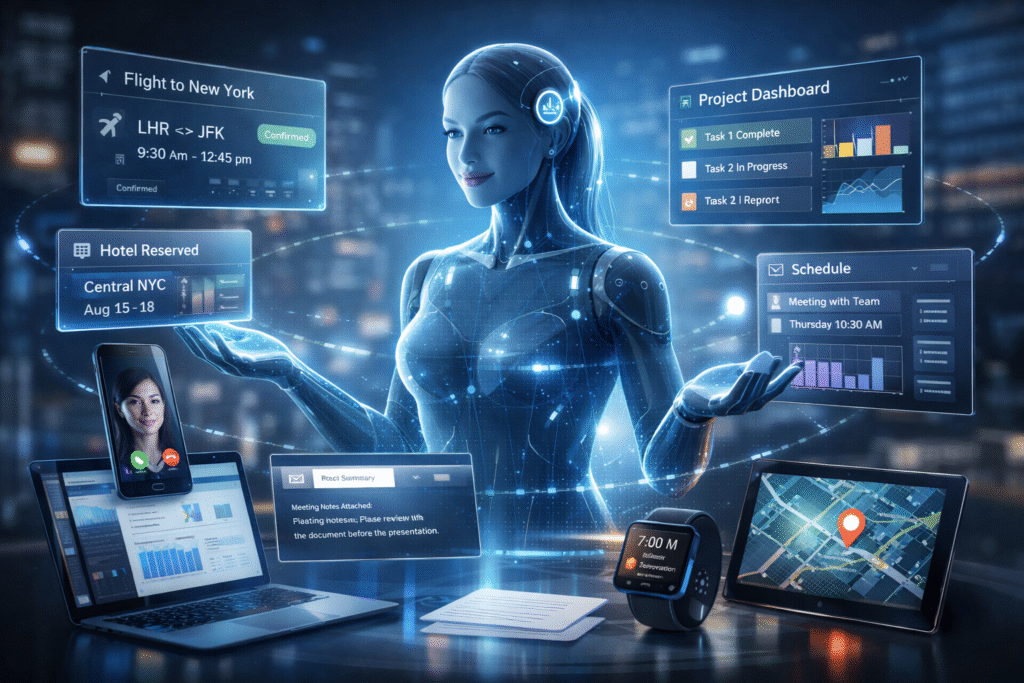
Agentic AI systems are moving beyond chat to autonomously manage complex digital tasks.
For much of the past two years, artificial intelligence has been defined by chat. Typing questions into conversational interfaces became the public’s main interaction with advanced AI, shaping perceptions of what these systems could — and could not — do. But quietly, the industry has been moving beyond chat windows.
A new generation of AI is emerging: agentic and multimodal systems designed not just to respond, but to act.
These AI agents are built to understand goals, make decisions and carry out complex tasks across multiple digital environments. They can analyse text, interpret images, process video and coordinate actions — often with minimal human supervision. In doing so, they are reshaping how people interact with technology in everyday life.
From Assistants to Autonomous Agents
Traditional digital assistants were reactive. They answered questions, set reminders or played music when asked. Agentic AI operates on a different principle. Instead of waiting for instructions at every step, these systems can take a high-level objective and break it down into a sequence of actions.
Ask an AI agent to organise a business trip, for example, and it can search flights, compare prices, book accommodation, update calendars and notify colleagues — all within defined constraints. In the workplace, similar systems can manage projects, track deadlines, summarise meetings and adjust plans as circumstances change.
This shift marks a move from AI as a tool to AI as a collaborator.
The Power of Multimodal Intelligence
What makes this evolution possible is multimodal capability. Modern AI systems are no longer limited to text alone. They can interpret images, audio and video, allowing them to understand the world in a more human-like way.
An AI agent can review a document, analyse a chart, watch a video demonstration and cross-reference all three to make informed decisions. In practical terms, this opens the door to more intuitive interactions — from analysing visual data in healthcare to managing creative workflows in media and design.
Multimodal AI also reduces friction. Users no longer need to translate everything into text. A screenshot, voice note or short video can be enough for an AI system to understand a problem and respond intelligently.
Why Autonomous AI Is Gaining Momentum
The growing interest in AI agents is driven by scale and efficiency. As digital systems become more complex, managing them manually becomes increasingly inefficient. Agentic AI promises to reduce cognitive overload by handling routine coordination and execution, freeing humans to focus on judgement and creativity.
Businesses are particularly keen on this model. Autonomous systems can operate continuously, adapt to new information and maintain consistency across tasks. Used responsibly, they offer significant productivity gains without requiring organisations to dramatically expand their workforce.
New Risks and New Responsibilities
Autonomy, however, brings new challenges. An AI agent capable of taking action must also be governed carefully. Errors, bias or unintended consequences can scale quickly if systems are poorly supervised.
As a result, developers and regulators are paying closer attention to safeguards. Human oversight, clear boundaries and accountability mechanisms are becoming central to how autonomous AI is deployed. The goal is not to remove humans from decision-making, but to ensure AI systems operate within defined ethical and operational limits.
Everyday Technology, Redefined
For consumers, the rise of AI agents may feel less dramatic — and more natural — than previous technological shifts. Booking travel, managing finances, organising schedules or troubleshooting devices could soon happen largely in the background, guided by AI systems that anticipate needs rather than react to commands.
The transition will not be immediate, nor uniform. But as agentic and multimodal AI becomes more reliable, the line between user and system will continue to blur.
A New Relationship With Machines
The rise of autonomous AI marks a turning point in how technology fits into daily life. The question is no longer whether machines can understand us, but whether they can act on our behalf — responsibly, securely and in alignment with human intent.
In that sense, the next wave of AI is less about conversation and more about collaboration. Your next digital assistant may not just answer questions — it may get the job done.
Source
Editorial analysis based on current industry developments and global reporting on agentic AI systems, multimodal artificial intelligence, and autonomous digital agents.