

The UK technology platform combines website monitoring, GDPR scans and website compliance checks to help website owners identify downtime, performance problems and potential compliance issues from one simple dashboard.
As businesses depend more heavily on their digital presence, website monitoring, GDPR scans and compliance checks are becoming harder to treat as optional extras. Yet for many small companies, monitoring a website still means waiting for a customer to report that something has gone wrong. SREMonitor.io is taking a different approach, bringing reliability, performance and compliance visibility together in a platform designed to make website health easier to understand.
A website may be one of the hardest-working assets in a modern business. It can generate enquiries while the office is closed, process transactions from customers thousands of miles away, collect leads, accept bookings and represent a company to potential customers who may never visit a physical location. And the scale of this digital economy continues to grow.
As Global Elite Business Magazine explored in its feature on the global website economy, the world’s enormous website ecosystem has created an equally significant economy around hosting, security, development, optimisation and the technologies required to keep those websites operating.
But there is a less visible part of that economy: what happens after a website has been built? Who is watching it? Who notices when it becomes unavailable? Who identifies deteriorating performance? And as analytics platforms, cookies, forms and third-party services are added, who checks whether the website has developed new privacy or compliance concerns?
For large corporations, these questions are usually answered by technology teams equipped with sophisticated monitoring and observability systems. For millions of smaller businesses, the answer can be considerably less sophisticated. Sometimes, nobody is watching at all. That is the problem SREMonitor was created to address.
From Enterprise Site Reliability Engineering to the Small Business Website
SREMonitor was founded by technology professional Sowmya Shree, following more than 15 years working at a Tier 1 investment bank and extensive experience in Site Reliability Engineering, or SRE.
Inside major technology organisations, monitoring is part of everyday operations. Critical systems are measured continuously, and engineering teams use observability platforms, dashboards, automated alerts, incident-management systems and service-level indicators to understand whether technology is behaving as expected. Downtime is not supposed to be discovered accidentally.
Shree saw a very different picture while developing websites for small businesses and friends outside the enterprise environment. Building a professional website had become remarkably accessible: hosting was readily available, cloud infrastructure had become easier to consume, and modern development tools had dramatically reduced the effort required to create sophisticated websites. But website monitoring had not necessarily followed the same path.
Powerful enterprise platforms can provide extraordinarily detailed observability, but their complexity and pricing are not always aligned with the needs of a small business owner or web agency managing relatively straightforward websites. A restaurant, consultancy, accountant, retailer or local services company does not necessarily need to operate an enterprise observability stack. It does, however, need to know when its website stops working.
That distinction became central to SREMonitor. Instead of asking smaller companies to adopt enterprise monitoring practices wholesale, the platform attempts to take some of the principles behind Site Reliability Engineering and make them accessible through a much simpler experience.
The wider technology landscape is moving in the same direction. As businesses invest in AI, cloud infrastructure and increasingly sophisticated digital services, the infrastructure supporting those services is becoming strategically important, a trend explored in GEBM’s analysis of the global AI infrastructure buildout.
When Your Customer Becomes Your Monitoring System
For a website owner, few messages are more frustrating than: “Just letting you know, your website appears to be down.” The person sending that message is often a customer.
Websites can become unavailable for many reasons. Hosting failures, DNS problems, application errors, configuration changes, certificate problems, unsuccessful deployments and third-party dependencies can all affect availability. Without website monitoring, an outage can remain unnoticed until someone happens to visit the site, and for a website generating sales or enquiries, that creates an obvious business risk.
Imagine an accountancy firm running a paid advertising campaign while its website is unavailable. Or an online retailer experiencing problems during a busy sales period. Or a consultancy whose contact page stops functioning while prospective customers are trying to make enquiries. In each situation, the technical incident can quickly become a commercial problem.
Automated website monitoring changes the model from discovery by accident to active observation. Instead of assuming that a website is available because it worked yesterday, monitoring checks it repeatedly, a principle large technology organisations have understood for decades. SREMonitor’s proposition is that smaller businesses should have access to the same basic principle without requiring an entire engineering department to implement it.
Website Health Is About More Than Uptime
Knowing that a website responds is important, but availability tells only part of the story. A website can technically be online while delivering a poor experience. Pages may load slowly, important content may take too long to appear, interactive elements may respond sluggishly, or the page layout may shift unexpectedly as content loads.
Google’s Core Web Vitals provide a framework for measuring important elements of that user experience, including Largest Contentful Paint, Interaction to Next Paint and Cumulative Layout Shift. SREMonitor incorporates Core Web Vitals visibility alongside website monitoring, allowing website owners to look beyond a simple up-or-down status.
That matters because the question businesses ultimately need answered is not simply “is my website online?” It is: “is my website healthy for the people trying to use it?” That broader definition of website health is where SREMonitor begins to differentiate its proposition, because performance is still only part of the picture. There is another area that small businesses increasingly need to consider: compliance.
Websites are also changing as AI transforms how customers discover businesses online. GEBM’s examination of the machine-readable brand and AI search highlights how websites increasingly need to serve not only human visitors but search engines and AI systems, making the operational quality of the website itself increasingly important.
The Compliance Problem Hiding Inside Everyday Websites
Even relatively simple business websites can process personal information. A contact form might collect a name, telephone number and email address. A newsletter subscription may collect customer details. Analytics tools can collect information about how people interact with a website, and advertising technology, embedded services and cookies can introduce additional data considerations. As websites evolve, these technologies can change without the privacy information surrounding the website necessarily changing with them.
For UK businesses, data protection responsibilities are governed by the UK GDPR and Data Protection Act 2018, with the Information Commissioner’s Office providing guidance to organisations on their responsibilities. For small businesses without specialist compliance teams, however, understanding what needs attention can be difficult.
SREMonitor approaches this through automated GDPR scans and website compliance checks. The idea is not that software can declare a company legally compliant, because it cannot. Instead, the platform is designed to identify potential issues and give website owners information they can investigate.
This distinction matters. A GDPR scan should be considered an additional visibility tool rather than a substitute for professional legal advice. But visibility itself can be valuable: a business cannot investigate a problem it does not know exists.
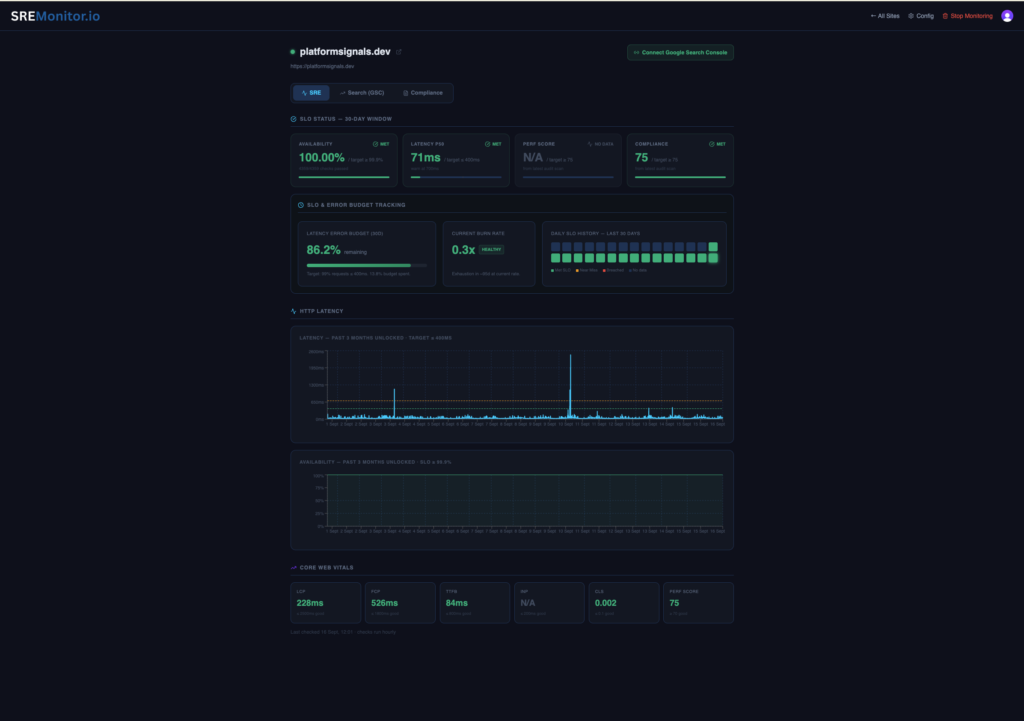
Alt text: SREMonitor GDPR scans and website compliance checks showing compliance findings
Making GDPR Scans More Accessible
For many smaller companies, GDPR can appear complicated long before they begin reviewing the actual requirements. Terms such as lawful basis, privacy notices, consent, processing, controllers and data subjects are familiar to privacy professionals but not necessarily to someone running a small company. This can create an unfortunate situation in which businesses recognise that compliance matters but are uncertain about where to start.
Automated GDPR scans can help reduce some of that uncertainty by providing an initial view of potential website-level issues. SREMonitor’s website compliance checks are designed to turn findings into information that is easier for website owners to review and understand, so the platform can become an early-warning mechanism.
It does not replace a lawyer or Data Protection Officer, and a successful automated scan does not guarantee compliance with all aspects of data-protection law. Instead, it gives the business another set of signals, a philosophy that closely resembles the monitoring principles from which SREMonitor originated. Monitoring cannot guarantee that a production system will never fail; it can help you detect when something appears wrong. Likewise, automated GDPR scans cannot make every compliance decision for an organisation, but they can highlight areas deserving attention.
Why Website Compliance Checks Cannot Be “One and Done”
Perhaps one of the biggest misconceptions surrounding website compliance is that it is something completed when a website launches. Modern websites rarely remain unchanged: a company might introduce a new analytics provider, a marketing agency could install another tracking technology, a developer may add a contact form, a business could introduce online bookings, or a new advertising campaign might require another integration. Each change potentially alters the website.
The Information Commissioner’s Office describes data-protection compliance as an ongoing process and advises organisations to consider privacy and data protection throughout the lifecycle of systems and services. That makes recurring website compliance checks particularly relevant. Instead of performing a review once and forgetting about it, businesses can periodically reassess their websites.
SREMonitor’s paid service extends its GDPR scans through automatic monthly rescanning, providing a mechanism for making compliance checks part of routine website operations. This represents a broader change in thinking: compliance becomes less of an annual administrative task and more like another component of website health.
Why Website Monitoring and GDPR Scans Belong Together
At first glance, website monitoring and GDPR scans may seem like unrelated technologies. One belongs to engineering, the other to compliance. From the perspective of a business owner, however, the distinction is much smaller. Both concern operational risk. A business wants its website to be available, it wants customers to have a good experience, it wants to know when something has changed, and it wants visibility into potential compliance concerns.
Combining website monitoring, performance visibility and website compliance checks creates a more complete picture of the digital property the business is operating. For SREMonitor, this intersection is central to the product. Rather than building another uptime checker or another standalone compliance scanner, the platform is attempting to create a broader website-health layer.
Simplicity as a Product Feature
The strongest technology is not necessarily the technology with the largest number of configuration options. For small businesses, simplicity itself can be valuable. The owner of a growing company may simultaneously be responsible for sales, marketing, recruitment, customer relationships and finances, and is unlikely to want to learn observability engineering simply to implement website monitoring.
SREMonitor therefore starts with something every website owner already has: a URL. There is no complex monitoring infrastructure for the customer to deploy before getting started. That ease of use extends to GDPR scans and website compliance checks, where the objective is to make the results understandable rather than exposing users to another highly technical interface. This potentially opens website monitoring to an audience that previously considered it too expensive, too complicated or simply unnecessary.
An Opportunity for Web Development Agencies
There is another group for whom this model may be particularly relevant: web developers and digital agencies. An agency may spend weeks designing and building a customer’s website, but once the site launches, the commercial relationship often changes. Maintenance packages usually concentrate on updates, backups and content changes.
Website monitoring creates an opportunity to expand that relationship into ongoing operational care. Instead of waiting for a customer to report an outage, agencies can incorporate monitoring into their service. Similarly, regular website compliance checks and GDPR scans could form part of a broader website-care package. For an agency managing dozens of customer websites, this creates the potential for a different kind of service relationship, one focused not simply on building websites but on maintaining their ongoing digital health.
Starting Without Another Large Software Commitment
Cost is another important consideration for smaller organisations. A monitoring product may solve a genuine problem, but if adopting it requires a substantial commitment before the customer has experienced its value, many small businesses will simply continue without monitoring.
SREMonitor addresses this with a free entry point. Website owners can begin monitoring a limited number of endpoints and perform a limited number of compliance scans without immediately committing to the paid service. Businesses requiring broader capabilities can then move to SREMonitor Pro, which expands the monitoring capacity and provides additional compliance functionality, including recurring rescans, more detailed findings and reporting. Current plans can be viewed on the SREMonitor pricing page.
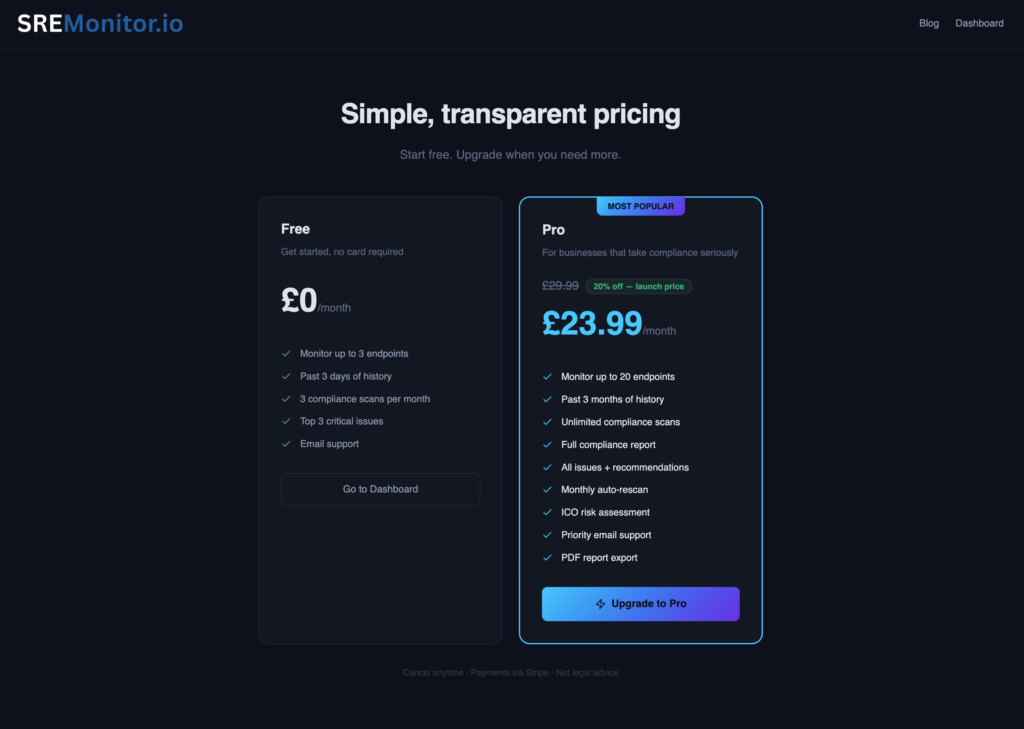
Alt text: SREMonitor website monitoring GDPR scans and website compliance pricing plans
From Reactive Website Management to Preventative Website Management
There is a larger idea behind SREMonitor that extends beyond any individual feature: do not wait for a problem before looking for it.
This is fundamental to Site Reliability Engineering. Enterprise engineering teams monitor infrastructure because discovering an incident through customers is inefficient. They measure performance because deterioration can occur gradually. They analyse signals because a small technical issue can eventually become a major service incident.
SREMonitor applies the same philosophy to smaller websites. Website monitoring provides visibility into availability. Core Web Vitals provide signals about performance and user experience. GDPR scans provide visibility into potential privacy and compliance concerns. Recurring website compliance checks encourage businesses to revisit those concerns as their websites change.
None of these tools eliminates risk. What they can reduce is the amount of time a business operates without knowing that a potential problem exists.
The Next Stage of the Global Website Economy
The tools for creating websites are advancing rapidly. Cloud platforms have made infrastructure easier to access, website builders have simplified design, modern frameworks have accelerated development, and AI-assisted coding is reducing the time required to create increasingly sophisticated digital products. Launching a website has arguably never been easier. Operating one responsibly is a different challenge.
As more businesses become digital-first, the technologies surrounding the website itself will become increasingly important. That includes security. It includes performance. It includes compliance. And it includes website monitoring.
The next stage of the website economy may therefore be less about whether businesses can establish a digital presence, and more about whether they can understand what is happening to that digital presence after it goes live. For a multinational corporation, that visibility might come from an entire Site Reliability Engineering organisation. For a small business, it needs to be considerably simpler. That is the space SREMonitor is positioning itself to occupy.
Its proposition is based on a straightforward principle: the benefits of continuous monitoring should not be restricted to organisations with enterprise technology budgets. Every organisation with an important website has something worth monitoring, and the same applies to GDPR scans and website compliance checks. As websites change, organisations need mechanisms that help them identify where closer attention may be required.
Ultimately, SREMonitor is attempting to change the question website owners ask. Not simply “is my website online?” but “is my website healthy?” For businesses increasingly dependent on their digital presence, the answer to that question is becoming more important every year.
About SREMonitor
SREMonitor is a website monitoring and compliance platform developed by MASA Ventures Ltd. It brings together website monitoring, Core Web Vitals, GDPR scans and website compliance checks to help website owners and digital agencies understand website health without building a complex enterprise monitoring environment.
Businesses can explore SREMonitor’s website monitoring and compliance platform or review the company’s monitoring and compliance pricing before getting started.
Automated GDPR scans and website compliance checks can identify potential issues and provide information for further review. They do not constitute legal advice or guarantee compliance with applicable data-protection legislation.