
 BANKING & FINANCE
 Introduction
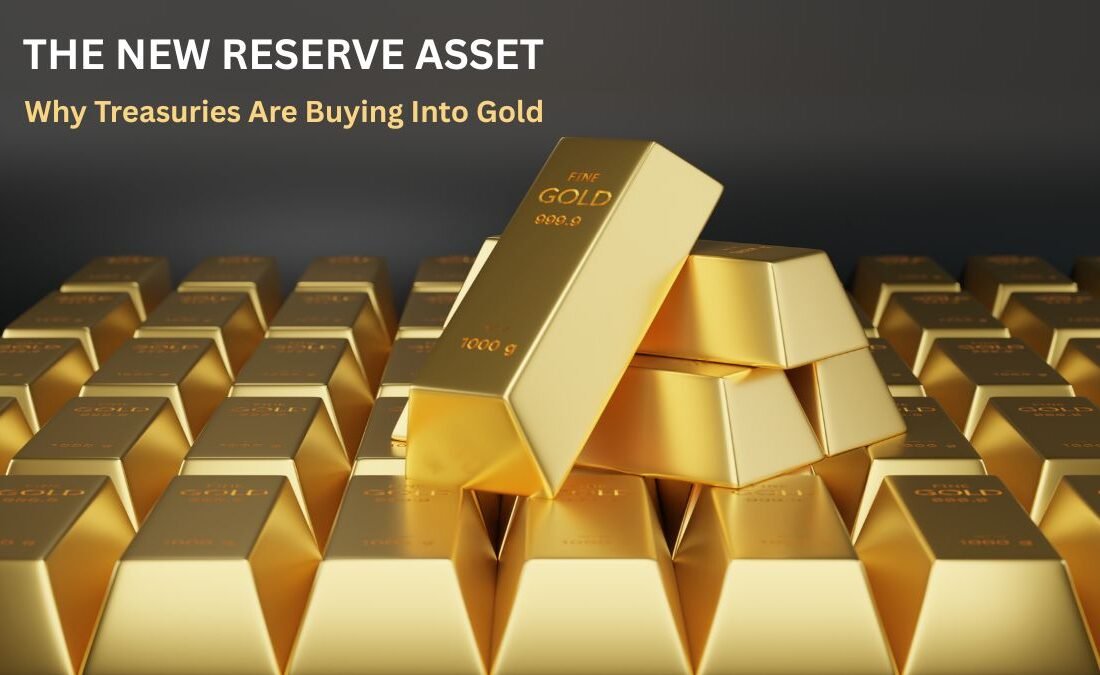
Gold has spent the past two years doing something it rarely does: dominating boardroom conversations that have nothing to do with jewellery or mining. The current gold bull run has taken prices from the low $2,000s to well above $5,000 an ounce, delivering one of the strongest annual performances in the metal’s modern history during 2025. What began as a defensive trade among central banks has evolved into something broader — a structural rethink of how corporate treasuries, pension funds and institutional investors allocate reserves in an era of persistent inflation risk, currency volatility and geopolitical fragmentation. For CFOs and treasurers, the question is no longer whether gold deserves attention, but how much of it, held where, and for what purpose. This article examines the forces behind the rally and the practical considerations shaping treasury strategy today.
Key Takeaways
- Gold has delivered its strongest run since 1979, driven by central bank buying, inflation concerns, expected interest rate cuts and geopolitical risk rather than retail speculation alone.
- Central banks purchased hundreds of tonnes of gold in 2025 and continued buying at a record pace into the second quarter of 2026, even as prices corrected.
- Regulatory changes under the Basel III framework have made allocated physical gold more attractive as a high-quality liquid reserve asset for banks.
- Corporate treasurers are increasingly evaluating gold as a diversification tool alongside, not instead of, traditional cash and fixed-income holdings.
- Gold carries real trade-offs — no yield, storage and custody costs, and price volatility — that require careful governance before any allocation decision.
- The structural drivers behind the rally, including reserve diversification away from the US dollar, are unlikely to reverse quickly, even if price momentum cools.
Why Gold Is Having a Historic Moment
A Rally Built on Multiple Drivers
Gold’s rise has not been driven by any single catalyst. Instead, several forces have converged. Persistent concerns about inflation and currency debasement have pushed investors towards assets with a long history as a store of value. Expectations of further interest rate cuts from the US Federal Reserve have reduced the opportunity cost of holding a non-yielding asset like gold, while a weaker dollar has made gold cheaper for buyers transacting in other currencies. Geopolitical tensions, from ongoing trade disputes to conflict risk in multiple regions, have reinforced gold’s traditional role as a haven when confidence in other assets wavers.
There is also a less obvious factor: growing unease among some investors about the independence of major central banks, particularly the Federal Reserve, amid political pressure over interest rate policy. Whatever the eventual outcome, that uncertainty alone has been enough to support demand for an asset that sits outside any single country’s monetary policy.
Central Banks Lead the Charge
If there is one constituency that has defined this cycle, it is central banks. According to the World Gold Council’s Gold Demand Trends data, official institutions purchased hundreds of tonnes of gold in 2025 — a figure that, while below the exceptional pace of 2022 to 2024, remained roughly double the average seen before 2022. Poland’s central bank was the standout buyer, adding gold to push its reserves to 550 tonnes, while Kazakhstan recorded its highest-ever annual purchase and Brazil returned to the market after a four-year absence.
That momentum did not fade in 2026. After a quieter first quarter, in which some central banks — Türkiye among them — trimmed holdings, the World Gold Council’s Q2 2026 Gold Demand Trends report recorded net central bank purchases of 289 tonnes, a 62% increase year-on-year and the strongest second quarter in the data series. Strikingly, this buying occurred while gold prices were posting their steepest quarterly decline in a decade, underlining that official-sector demand is driven by strategic reserve considerations rather than short-term price momentum.
The De-Dollarization Undercurrent
Much of this institutional buying sits within a broader shift in how reserve managers think about currency risk. Research published by the International Monetary Fund notes that gold’s share of central bank reserves climbed from around 10% in January 2019 to more than 22% by August 2025, a rise the IMF links to gold’s role as a hedge against interest rate risk and a partial offset to US dollar depreciation. The 2022 freezing of a portion of Russia’s foreign reserves is widely regarded as a turning point, prompting a number of emerging-market central banks to reassess how much of their reserves should sit in assets that can be frozen or sanctioned by another sovereign, versus a physical asset held domestically.
This does not mean the dollar’s dominant role in global finance is disappearing. It remains, by a wide margin, the leading reserve currency. But the marginal shift towards gold has been consistent enough, across enough countries, that most market analysts now treat it as structural rather than cyclical — a distinction that matters greatly for anyone deciding whether gold belongs in a treasury policy for the next several years, not just the next few quarters.
Why Corporate Treasuries Are Paying Attention
From Sovereign Reserve Asset to Corporate Balance-Sheet Tool
Corporate treasurers have historically left gold to central banks and specialist investors, favouring cash, government bonds and short-duration money market instruments for liquidity and safety. That is beginning to shift, particularly among multinational corporates with meaningful exposure to currency volatility, commodity input costs, or operations in jurisdictions with less stable monetary policy. For these organisations, a small, deliberate gold allocation is increasingly discussed alongside traditional treasury instruments as a way to diversify tail risk that cash and bonds cannot fully address, especially in an inflationary environment where real returns on cash have been under pressure.
Basel III and the Regulatory Tailwind
Regulatory treatment has reinforced this shift. Under the Basel III framework overseen by the Bank for International Settlements, physical gold held on an allocated basis has long qualified as a Tier 1, zero-risk-weighted asset for banks — a status the World Gold Council notes is not new but has become more consequential as the wider Basel III liquidity rules, including the Net Stable Funding Ratio, have been implemented. In the United States, the phased application of Basel III “Endgame” provisions has extended full high-quality liquid asset treatment to physical gold held by US banks, putting it on comparable regulatory footing to cash and Treasury securities for capital purposes. While this primarily affects banks rather than corporates directly, it has a knock-on effect: it deepens and improves the liquidity of gold markets that corporate treasurers ultimately rely on when they do choose to transact.
How CFOs and Treasurers Are Evaluating Gold in Practice
In practice, few corporate treasuries treat gold as a core operating asset. More commonly, finance teams run scenario analysis to understand what a modest allocation — often in the low single digits as a percentage of investable reserves — would do to portfolio volatility under different inflation and currency stress scenarios. Some multinational manufacturers with significant emerging-market currency exposure have explored gold-linked instruments as a partial hedge against local currency depreciation, particularly where formal hedging markets are shallow. Others, headquartered in economies with a history of currency instability, have considered allocated gold accounts as an uncorrelated store of value sitting outside the banking system.
Institutional investors, including pension funds and sovereign wealth funds, have moved further and faster than most corporates, often citing gold’s low correlation with equities and bonds during market stress as the rationale, rather than a view on price direction. That distinction — diversification tool rather than directional bet — is the one experienced treasury professionals return to most consistently.
Gold vs. Traditional Treasury Assets: A Comparison
| Attribute | Gold | Cash & Money Market Instruments | Government Bonds |
|---|---|---|---|
| Yield | None (opportunity cost) | Interest-bearing, typically modest | Coupon income, varies by maturity |
| Inflation protection | Historically strong over long horizons | Weak in high-inflation periods | Weak unless inflation-linked |
| Liquidity | Deep global market, but settlement and storage add friction | Highest liquidity | High, though price-sensitive to rates |
| Correlation to equities | Generally low or negative in stress periods | Low | Moderate, depends on rate environment |
| Credit/counterparty risk | None (physical) to low (allocated accounts) | Bank counterparty risk | Sovereign credit risk |
| Regulatory treatment | Tier 1 HQLA when held allocated, physical | Tier 1 asset | Tier 1/2 depending on issuer |
| Price volatility | Moderate to high | Minimal | Low to moderate |
Common Mistakes Organisations Make With Gold Exposure
Many organisations approach gold reactively, increasing exposure only after prices have already risen sharply, which risks buying near cyclical peaks rather than as part of a disciplined strategy. Others fail to distinguish between physical allocated gold, unallocated gold, gold ETFs and gold mining equities — each carries a different risk profile, and mining equities in particular introduce operational and equity-market risk that has little to do with the gold price itself. A further common error is treating gold as a substitute for proper currency and interest rate hedging programmes rather than a complement to them. Finally, some treasury teams underestimate the governance and custody complexity of holding physical gold, including insurance, audit and storage costs that can meaningfully affect the net economics of an allocation.
Future Trends: Gold Over the Next Three to Five Years
Looking ahead, several structural themes are likely to persist regardless of near-term price direction. Central bank diversification away from a dollar-only reserve model appears well established rather than a temporary response to one event, and reserve managers across emerging markets have signalled continued appetite for gold in forward-looking World Gold Council surveys. Corporate adoption is likely to remain gradual and concentrated among multinationals with genuine currency or geopolitical exposure, rather than becoming a mainstream treasury holding for most companies. Market analysts hold a wide range of views on where prices head next, which is itself a reminder that gold should be assessed through the lens of strategic diversification rather than short-term prediction. Technology may also play a growing role, with digital gold platforms and tokenised allocated gold products potentially lowering the operational barriers that have historically kept smaller corporates out of the market.
Frequently Asked Questions
Why are central banks buying so much gold right now? Central banks are diversifying reserves partly in response to geopolitical risk, including the precedent set by the freezing of sanctioned reserves in 2022. Gold carries no counterparty or credit risk and cannot be frozen by another government, making it attractive as a strategic reserve asset alongside currencies and bonds.
Should corporate treasuries hold physical gold? Most corporate treasuries that consider gold do so through allocated accounts, ETFs or futures rather than holding bars directly, given the custody and insurance complexity involved. The right vehicle depends on the company’s liquidity needs, risk appetite and existing hedging infrastructure.
Does gold protect against inflation? Gold has historically preserved purchasing power over long time horizons, though its performance over shorter periods can be volatile and is not a reliable one-to-one inflation hedge in every cycle.
How much of a treasury portfolio should be allocated to gold? There is no universal figure, and treasurers should not treat gold as a default allocation. Organisations that do add gold typically start with a small percentage of investable reserves, informed by scenario testing rather than a fixed industry benchmark.
Is gold’s bull run driven by speculation? While speculative and retail investment flows play a role, the current cycle has been distinguished by sustained central bank and institutional buying tied to reserve strategy, which analysts generally view as a more structural driver than short-term speculative positioning.
What is the Basel III impact on gold demand? Basel III’s liquidity framework treats allocated physical gold as a Tier 1, zero-risk-weighted asset for banks, and the phased introduction of related rules for US banks has reinforced gold’s standing as a high-quality liquid asset, indirectly supporting deeper and more liquid gold markets.
What are the main risks of holding gold in a corporate treasury? Key risks include price volatility, the absence of any yield, storage and custody costs for physical holdings, and the operational complexity of integrating gold into existing treasury and accounting systems.
How does gold compare with gold mining stocks as an exposure? Gold mining equities offer leveraged exposure to the gold price but also introduce company-specific operational, geological and equity-market risks that physical or allocated gold does not carry, making the two very different instruments for treasury purposes.
Final Thoughts
What makes this gold cycle distinct is not simply the scale of the price move, but who is driving it. When central banks buy hundreds of tonnes in a quarter while prices are falling, that is not a speculative trade — it is a statement about how reserve managers view risk in a fragmented, sanctions-aware financial system. Corporate treasurers do not need to draw the same conclusions as a central bank, and gold will remain a supporting, rather than core, holding for most balance sheets. But the underlying question gold’s rally has forced into boardrooms — how much currency, counterparty and geopolitical risk sits inside a treasury’s cash and near-cash holdings — is one every finance leader now has good reason to revisit, independent of where the gold price goes next.