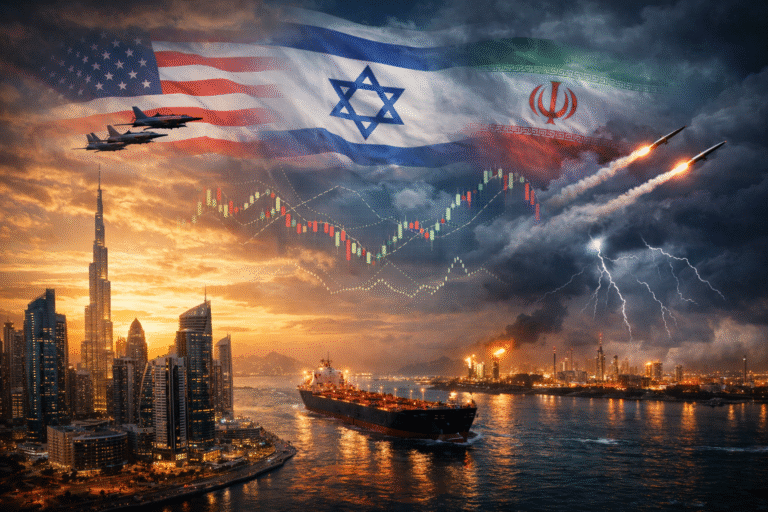

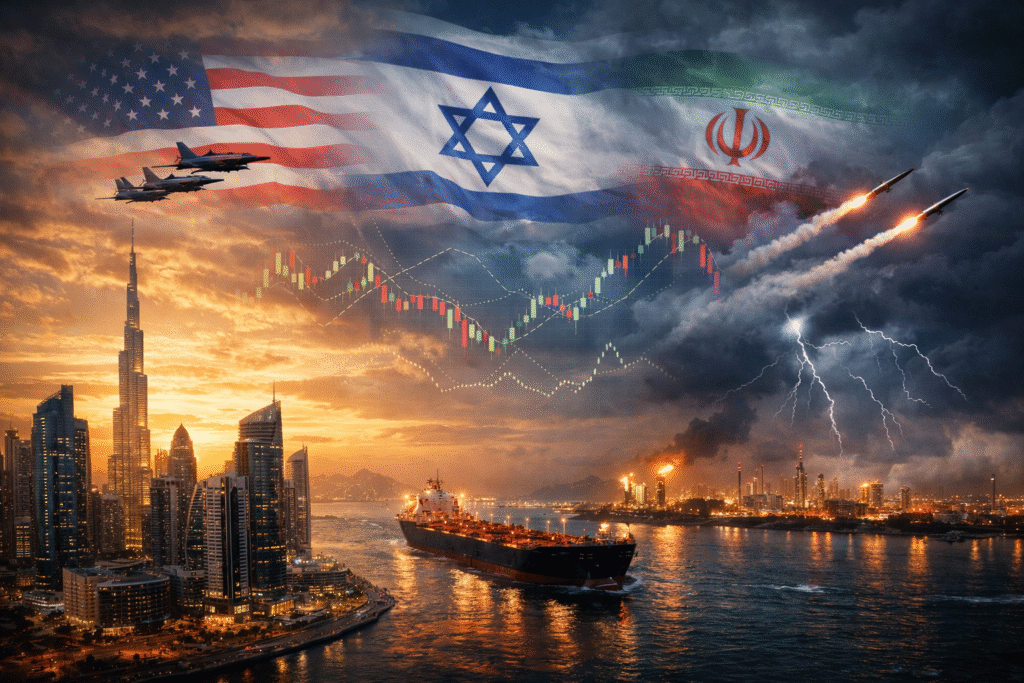
Rising tensions between the US, Israel, and Iran disrupt energy markets and Middle East business stability.
As tensions escalate between the United States, Israel, and Iran, the consequences are extending far beyond military strategy and diplomatic maneuvering. The evolving conflict is rapidly transforming the economic landscape of the Middle East, impacting energy markets, supply chains, investor confidence, and regional growth trajectories.
For business leaders, investors, and policymakers, this is no longer just a geopolitical story — it is an economic turning point.
🌍 A Region on Edge
The Middle East has always been central to global commerce due to its energy dominance, strategic trade routes, and sovereign wealth capital flows. Any confrontation involving major regional and global powers immediately sends shockwaves through financial markets.
The current conflict has intensified concerns over security, stability, and economic continuity. Businesses operating across the Gulf, Levant, and surrounding trade corridors are reassessing operational risk, insurance costs, and expansion plans.
🛢 Energy Markets: The First Casualty
Energy is the most immediate pressure point.
Nearly one-fifth of the world’s oil supply passes through the Strait of Hormuz, making it one of the most critical maritime chokepoints on the planet. Any threat to shipping routes or energy infrastructure creates instant volatility in oil and gas markets.
Business implications include:
- Rising fuel and logistics costs
- Higher input costs for manufacturing
- Inflationary pressure across oil-importing nations
- Increased insurance premiums for tankers and cargo
Energy-dependent industries — aviation, shipping, heavy manufacturing, and petrochemicals — are particularly exposed.
🚢 Supply Chains Under Stress
Even without full-scale trade disruption, the perception of instability can alter shipping routes and investor behavior.
Companies may:
- Divert cargo to longer routes, increasing delivery timelines
- Stockpile raw materials to hedge against disruption
- Shift sourcing strategies toward alternative suppliers
These defensive measures, while prudent, raise operating costs and reduce margins — especially for small and mid-sized enterprises trading heavily with the region.
📉 Investor Sentiment & Financial Markets
Geopolitical instability typically triggers capital flight toward safe-haven assets. During prolonged tensions, markets often experience:
- Equity volatility
- Stronger demand for gold and stable currencies
- Delayed IPOs and cross-border investments
- Cautious private equity deployment
Sovereign wealth funds and institutional investors in the Gulf may also adopt more conservative strategies until clarity emerges.
For startups and growth-stage businesses in the region, funding cycles could slow, especially in sectors sensitive to global risk perception.
🏗 Sector-by-Sector Impact
Energy & Petrochemicals:
High volatility but potential short-term revenue upside for producers.
Aviation & Tourism:
Airspace restrictions and safety concerns can reduce passenger flows.
Real Estate:
Luxury and commercial real estate may see slower foreign investment inflows.
Technology & E-commerce:
Operational resilience becomes critical, especially for logistics-dependent platforms.
Defense & Cybersecurity:
Increased government spending may accelerate growth in these sectors.
🔮 Strategic Business Response
While uncertainty dominates headlines, resilient organizations are focusing on:
- Geographic diversification
- Risk-adjusted investment models
- Stronger regional partnerships
- Scenario planning for prolonged disruption
Companies that adapt quickly — balancing caution with strategic positioning — may emerge stronger once stability returns.
🧭 The Long-Term Outlook
History shows that markets eventually stabilize, even after severe geopolitical crises. The critical variable is duration. A short-term escalation may produce temporary volatility. A prolonged conflict, however, could permanently reshape trade routes, alliance structures, and capital flows across the Middle East.
For global businesses, the message is clear: geopolitical risk management is no longer optional — it is central to corporate strategy.